
Dacorum councillors refused by 6-5 to drop the Green Belt objection to 1,400 homes east of Tring. It now defends the refusal at a November inquiry.
Dacorum councillors have voted by six to five to keep fighting the Green Belt objection to up to 1,400 homes east of Tring. The draft minutes of the decision were published this week.
The vote settles a question we reported before the meeting: whether the council should stop defending the first of the seven reasons it gave for refusing the scheme in April. The appellant has told the inspector it will apply for a full award of costs against the council.
The inquiry opens on 10 November 2026. Its Planning Inspectorate reference is 6009233.
The motion, and the vote
The Development Management Committee met on 10 September. Councillor Guest, who chaired the meeting, put the following motion to members:
That the development Management Committee, having considered the changes in material circumstances and planning policy since the decision of April 2026, concludes that Very Special Circumstances now exist to justify the inappropriate development in the Green Belt and therefore agrees that the Council should no longer contest Reasons for Refusal one.
Councillor Maddern proposed it and Councillor Bristow seconded it. Councillor Williams asked for a recorded vote, seconded by Councillors Douris and Durrant.
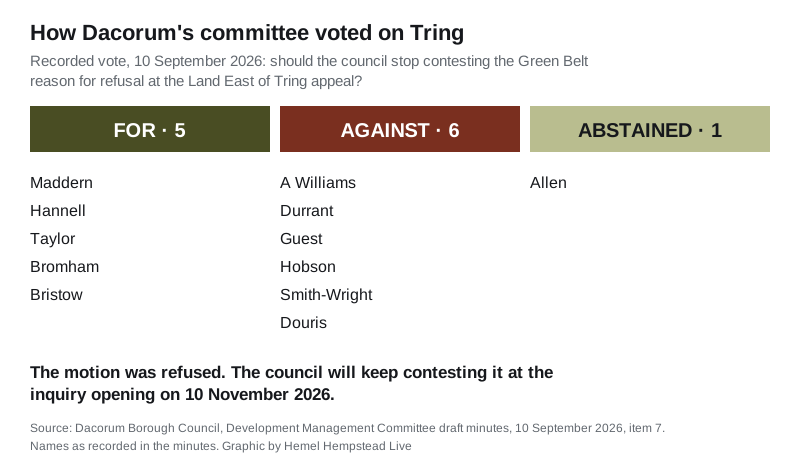
Five members voted for the motion: Maddern, Hannell, Taylor, Bromham and Bristow. Six voted against: A Williams, Durrant, Guest, Hobson, Smith-Wright and Douris. Councillor Allen abstained. Councillor Guest, who put the motion to the committee, voted against it.
The motion was refused. The council will therefore continue to contest reason for refusal one at the appeal.
Four of the twelve members present were substitutes. Apologies came from Councillors Patterson, Symington, Riddick and Jankowski, with Bristow, Allen, Douris and Taylor standing in (draft minutes). Of those four, Bristow and Taylor voted for the motion, Douris against, and Allen abstained. On a one-vote margin, the four apologies mattered.
Councillor Sheron Wilkie, a parish councillor and two residents made statements on the item. The minutes do not record what any of them said.
Why members were asked at all
Officers did not recommend either course. The report put to them says so in terms:
Officers are not making a recommendation as to whether Members should alter their previous resolution.
What had changed was the national rulebook. A revised National Planning Policy Framework replaced the previous version on 17 August, and officers re-ran the April planning balance against it (committee report).
Three benefits moved up from limited weight to substantial weight: schools and educational facilities, community facilities, and recreational and sporting facilities. No harm previously identified gained any weight. Substantial weight on Green Belt harm, openness and Green Belt purposes all stayed as they were, as did the weight on the Chilterns National Landscape, heritage, landscape character and the loss of farmland.
One change went the other way. The new Policy L3 sets a minimum density where a site is within reasonable walking distance of a station. The part of the Tring site nearest the station does not meet it, so the report identified a fresh policy conflict there.
The costs risk members were warned about
The report set out the rule in full before the vote. Government guidance treats “unreasonably defending an appeal and pursuing reasons for refusal which are not supported by sufficient evidence” as an example of unreasonable behaviour, which can bring a costs award.
Officers were careful on both sides of it:
- departing from professional officer advice is not, of itself, unreasonable
- but maintaining a reason for refusal that cannot then be substantiated at the inquiry carries a risk that the council is found to have acted unreasonably
- and the money is not a planning consideration and must not influence how members weigh the merits, citing the Court of Appeal in East Bergholt Parish Council v Babergh District Council
Officers also told members they should resolve not to defend the appeal if the April position “was not capable of being defended”. Six of the twelve took the opposite view.
The other six reasons for refusal
Reasons two to seven were never about the merits. They recorded legal agreements that had not been signed on the day of the April decision. The council, Hertfordshire County Council and the appellants are still working on them.
If the obligations are secured before the appeal is determined, officers consider those six reasons would fall away and would not be pursued at the inquiry. If any are still outstanding, the council has to revisit its position on them.
What else is riding on this
The same land is proposed allocation TR03 in the council’s emerging Local Plan. The Local Plan Inspectors wrote to the council on 14 July asking for further justification for the size, scale and location of TR03, having regard to Green Belt and landscape considerations. They accepted that some Green Belt alteration will be necessary to meet housing need and that some growth at Tring is logical.
They offered the council three options. On 31 July the council confirmed it would provide the extra information rather than change the policy, and it maintains that TR03 as submitted is sound. The Inspectors have said their views so far are not their final findings. That examination is still running.
So the council is in the position of defending a refusal of the scheme at appeal while promoting the same land for housing in its Local Plan.
Two figures give the backdrop. The council’s housing land supply is 1.18 years. And of the 35 appeals Dacorum had decided in 2026 up to 9 September, 24 were dismissed and nine allowed. Only one allowed appeal came from a committee decision made against the officer recommendation (September appeals update). That is a single case, so it proves nothing about how November will go.
What it means for you
- Nothing is decided. The inspector decides the appeal, not the council. The committee decided only what case the council will argue.
- The inquiry opens on 10 November 2026. Inquiries are held in public. Anyone who made representations on the application can usually take part. The venue and timetable are set by the Planning Inspectorate under reference 6009233 and have not yet been published by the council.
- If costs are awarded against the council, residents pay them. The sum would come out of the council’s budget. No figure has been put on it publicly, and an application has not yet been made, only signalled.
- The Local Plan is the other route to the same outcome. The scoping consultation on the next Local Plan, to 2045, closes at 5pm on 2 October, and the call for sites closes at 5pm on 23 October. See our Local Plan 2045 report.
- To follow the appeal, the council’s appeals update goes to the Development Management Committee each month. The next meeting is 24 September. New applications in the borough are on our planning news page.
Sources
- Dacorum Borough Council, Development Management Committee draft minutes, 10 September 2026, for the motion, the recorded vote and every name, the substitutes, the speakers and the outcome.
- Item 7, Land East of Tring 25/01880/MOA update following publication of the 2026 NPPF, for the absence of an officer recommendation, the weight changes, the Policy L3 conflict, the costs advice, the position on reasons two to seven, the TR03 examination and the 1.18-year housing land supply.
- Item 6, appeals update, September 2026, for the 10 November inquiry date and the 2026 appeal totals.
- Development Management Committee agenda, 24 September 2026, for the next meeting.
Have your say